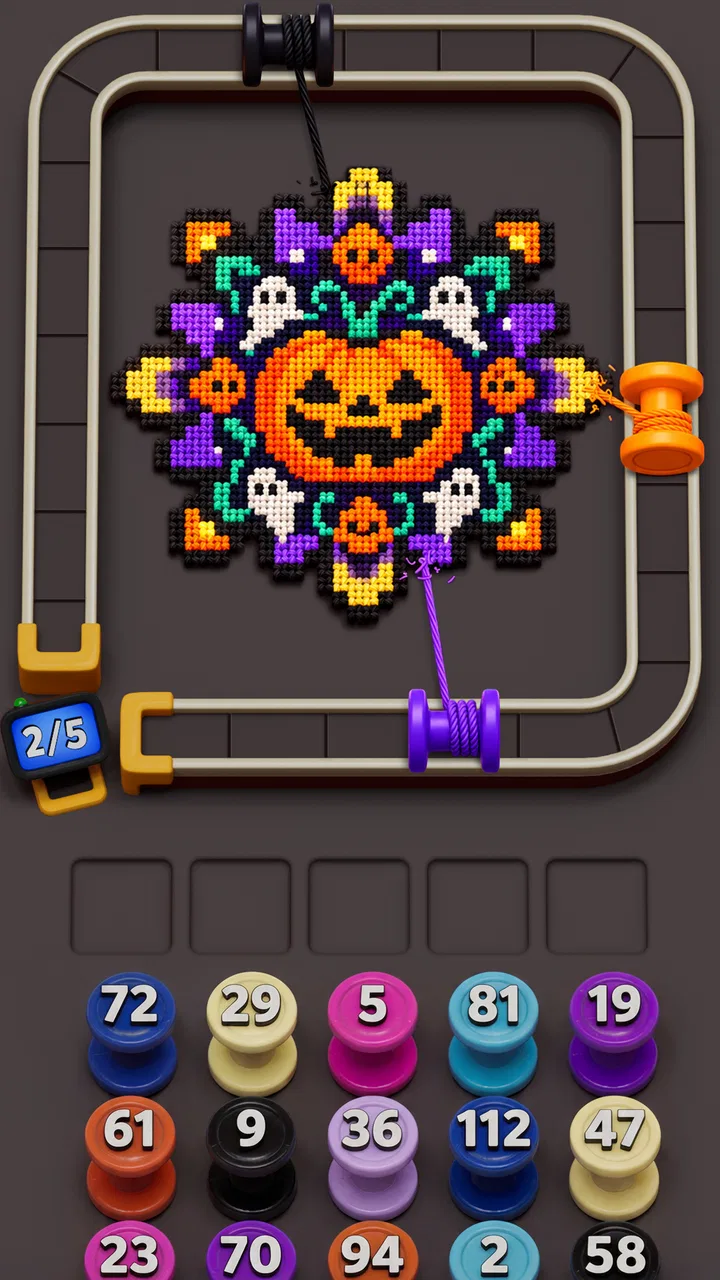
Yarn Loop
- 4.5
- Rating
- 1.00M
- Installs
- Free
- Price

 Analysis by App-foxy
I went into Yarn Loop expecting a light puzzle to fill a few spare minutes, and that is exactly where it works best. This free game from Combo Game turns yarn into the central visual idea, asking me to think about loops, paths, and the order in which a puzzle should be untangled. It is simple to understand, but the better moments come from slowing down and noticing how one small move changes the whole board.
That makes it a comfortable choice for anyone who enjoys casual puzzle games without wanting a complicated story, a large cast of characters, or a long tutorial. I can start quickly, experiment, make a mistake, and try again without feeling as if I have lost a major investment of time. The game is listed for Everyone, so its accessible presentation should suit a broad audience, including players who prefer calm visual challenges over fast reactions.
After spending time with it, my overall impression is positive but specific: this is not a replacement for a deep strategy game or a traditional match-three title. Its appeal comes from the physical feeling of arranging and correcting a tangled idea. When the board begins to make sense, I get a small but satisfying release of tension, and that feeling is strong enough to make me start another puzzle.
You May Also Like

 Blood Strike: 2.5 Anniversary
Blood Strike’s Loadouts Turn Every Drop Into a Tactical Gamble
A close look at Blood Strike’s custom loadouts: how fast access to signature weapons reshapes its battle royale rhythm, rewards preparation, and narrows the gap between fights.

 Pandora - Music & Podcasts
Pandora’s Music Is Easy to Start, but Harder to Recover
Pandora’s strength is its low-effort path from a seed to a station. Its weak spot is how much confidence it asks you to place in connection, setup, and quiet recovery.

 8 Ball Pool
 Is Built on Rivalries, Rematches, and Routine
A close look at the rivalries, rematches, shared routines, and unanswered safety questions that turn a quick pool match into a persistent mobile community.

 Samsung Music
’s Quiet Strength Is Playing What You Already Own
Its reach comes less from spectacle than from dependable access to a personal library. That simplicity is both the app’s strongest retention engine and its ceiling.

 AccuWeather: Weather Radar
AccuWeather Review: A Quick, Clear Forecast for Everyday Decisions
For everyday plans, the best forecast is the one you can understand quickly. AccuWeather makes rain timing, radar, and local conditions easy to act on, with a few trade-offs.

 Hill Climb Racing
Why Hill Climb Racing Still Turns Crashes Into One More Run
A tiny car, a bumpy hill and one more upgrade: Hill Climb Racing keeps resurfacing because its simple chaos makes every near-miss feel personal.
More From Our News Desk
View All News


How the yarn puzzle loop feels in actual play
I find the yarn puzzles most rewarding when I pause before moving anything and decide which part of the layout is actually causing the confusion. That small change in approach turns a quick tap-around into a more deliberate test of cause and effect. It also makes each attempt useful: even when my plan fails, I leave with a clearer idea of what to inspect next.
The first action is easy to understand
The best part of the opening experience is that the basic intention is clear. I look at the yarn arrangement, identify what seems out of place, and begin testing a move. There is no need to learn a complicated control scheme before the puzzle becomes meaningful. The game’s short description, “Yarn Loop,” is a good indication of its central idea: the pleasure comes from working with connected paths rather than simply tapping random objects.
That first move matters because it immediately turns the puzzle from a static picture into a problem I can investigate. I am not just searching for a correct button; I am forming a small theory about how the yarn should sit. If a move improves the arrangement, I have a clue. If it makes the layout more awkward, I can reconsider without much frustration.
I found it useful to begin with the most visibly restricted part of the board rather than moving whichever piece catches my eye first. A loop that seems to block several paths often gives more information than an isolated section. This is a small habit, but it makes the early stages feel less like guessing and more like reading the structure of the puzzle.
That approach also helps younger or less experienced players. The game can be approached intuitively, while patient players can look for relationships between several pieces before committing to a move. I would recommend it to someone who likes puzzles that reveal their logic gradually, especially if they enjoy handling one local problem and then seeing how it affects the wider arrangement.
Feedback creates a steady rhythm
Yarn Loop is most enjoyable when I pay attention to the feedback after every action. A useful move does not merely change the screen; it gives me a clearer sense of direction. The board becomes easier to read, a path looks more natural, or a previously confusing section starts to fit with the rest. That response encourages another move because I feel I am learning the puzzle rather than blindly cycling through possibilities.
The rhythm is simple: inspect, adjust, observe, and update my plan. That rhythm is the real engine of the game. It does not depend on a dramatic story beat or a complicated reward system. Instead, each correction supplies a small piece of information, and several pieces of information eventually become a solution.
This is where the game differs from a conventional match-three puzzle. In a match-three game, the board often changes because of combinations, falling pieces, or a limited number of turns. Here, the satisfaction is more deliberate. I am trying to understand a layout and improve it through controlled changes. Players who enjoy visual organization may find this more rewarding than chasing a high score through rapid combinations.
It also differs from a word puzzle. There is no need to search for vocabulary or recall facts. The challenge is spatial, so the useful skill is recognizing connections and predicting consequences. That makes it a good option when I want something mentally active but do not feel like reading clues or calculating numbers.
There is a trade-off, though. Because the feedback is based on arrangement and visual clarity, players who prefer loud effects, constant action, or highly varied objectives may find the pace too restrained. I would not choose this as my main game during a commute if I wanted quick bursts of excitement. I would choose it when I wanted a quiet problem that could hold my attention without demanding frantic reactions.
The reward is the solved shape
The strongest reward in this kind of game is not a complicated collection system. It is the moment when the yarn arrangement finally looks right. I can feel the difference between a board that is merely less confusing and one that has reached a coherent solution. That visual resolution gives the puzzle a clean ending, which is important because it makes the effort feel worthwhile.
I especially like the way this reward grows from my own decisions. The finished arrangement is satisfying because I remember the awkward starting position and the wrong turns along the way. The game turns a small visual correction into a miniature accomplishment. That is a better fit for short, repeatable play than a large reward that interrupts the puzzle itself.
For an everyday example, I can imagine opening it while waiting for an appointment. I might solve one puzzle while standing in line, put the phone away, and return later without needing to remember a long story or rebuild a strategy from scratch. The attraction is not that every session becomes an event; it is that a small amount of attention can produce a complete sense of progress.
That makes the game suitable for people who enjoy finishing individual tasks. If I am the kind of player who likes clearing a board before moving on, the yarn theme supports that habit well. It gives each puzzle a visible before-and-after state, so the reward is easy to understand even without a large amount of explanation.
At the same time, players looking for a strong long-term progression system should set their expectations accordingly. The satisfaction is concentrated in solving the current arrangement. If I need character upgrades, competitive rankings, or a detailed narrative to keep me engaged, another puzzle category may offer more lasting variety.
Resetting the session keeps the pressure low
One reason I can return to Yarn Loop is that a failed attempt does not feel disastrous. Puzzle games are much easier to enjoy when experimentation is safe. I can try a different order, rethink an earlier assumption, and approach the same board with a cleaner plan. That reset is not just a convenience; it is part of the learning process.
The best way to use a reset is to treat it as a new reading of the board rather than as a punishment. If I repeatedly move pieces without understanding why, starting over will not help much. If I pause and identify the section that caused the problem, the next attempt becomes more focused. I found that taking a moment to inspect the full layout before touching anything often saves more time than making several quick corrections.
A useful personal rule is to separate exploration from commitment. Early moves can test a possibility, but once a section begins to look coherent, I try not to disturb it casually. This protects the progress I understand and keeps the puzzle from becoming a blur of constant rearrangement. It is a small workflow, yet it makes the game feel more thoughtful.
The reset loop is also why the game can work for different attention levels. I can play with full concentration and search for an efficient solution, or I can use it more casually and accept a few wrong turns. The same puzzle supports both moods. That flexibility is more valuable to me than a forced timer, because it lets the game fit around the day instead of controlling the day.
Where the experience may lose momentum
The same focused design that makes Yarn Loop approachable can limit its appeal. A player who wants constant novelty may eventually feel that the core interaction is too narrow. Rearranging yarn is the point, but it is also the boundary of the experience. If the visual language does not appeal to me, there is not a separate combat mode or story mode to provide a different reason to continue.
I also think the game is better for deliberate play than for distracted tapping. Looking at the whole arrangement matters, and a small screen can make a busy puzzle harder to interpret when I am moving quickly. I prefer to play with the phone held steadily and the display free from other distractions. That is not a serious flaw, but it is worth knowing if I usually play while multitasking.
Another limitation is the presence of optional purchases. The game itself is free, while individual in-app purchases range from $0.99 to $99.99. That wide range means I would pay attention before confirming anything, particularly if I were handing the device to a child. The Everyone age rating makes the game broadly approachable, but age suitability and spending awareness are separate issues.
For my own use, I would treat the free download as the proper starting point and decide later whether any paid option genuinely improves my experience. I would not install it expecting every player to need purchases. The core reason to play is the puzzle loop, so I would judge the game by how much enjoyment I get from solving boards rather than by the existence of optional spending.
Who should try it, and who should skip it
I would recommend Yarn Loop to players who like visual logic, tidy arrangements, and puzzles that reward patience. It is especially suitable for short breaks, quiet evenings, and anyone who enjoys making progress through small corrections. Families may also appreciate the accessible age rating, provided that adults keep an eye on purchases when necessary.
I would be less likely to recommend it to someone who needs a strong narrative, competitive pressure, or rapid action. A player who prefers wordplay should choose a word game, while someone who enjoys cascading combinations may be happier with match-three gameplay. Those alternatives are not automatically better; they simply create a different kind of feedback. Yarn Loop is about understanding a shape, not chasing speed or building a large personal collection.
It is also not my first choice when I want a game that teaches a complex system over many hours. The appeal is immediate and focused. That is a strength for casual play, but it can feel limited to players who measure value by the number of mechanics, modes, or strategic layers available.
Practical details before installing
Combo Game is the developer behind this puzzle, which was released on December 19, 2025. The current version is 1.22.0, and it runs on Android 7.0 or later. Those details make it a reasonable option for people using an older compatible Android device, although I would still keep the operating system updated when possible for general device reliability.
The game is free to install, and its growing audience is reflected in more than one hundred thousand installs. It holds a 4.5 average from around two and a half thousand ratings, along with roughly three hundred forty-five written reviews. I see those figures as encouraging signs of interest, but I would still base my decision on whether the yarn-based puzzle style matches my taste.
Because the download costs nothing, the main decision is not whether the entry price is acceptable. It is whether I enjoy the repeated cycle of examining, adjusting, solving, and beginning again. The purchase range is the part I would approach carefully, especially on a shared device. I would also make sure the phone meets the Android requirement before expecting the game to run.
My verdict on the complete loop
Yarn Loop succeeds because its loop is easy to feel. I take a first action, receive visual information, make a more informed correction, and eventually reach a satisfying arrangement. If I make the wrong choices, I reset and try again with a better understanding of the board. That sequence gives the game a gentle pull: one more attempt seems reasonable because the last attempt taught me something.
My favorite quality is the balance between accessibility and thought. I do not need specialist knowledge, but I cannot solve everything by tapping without looking. The yarn theme gives the puzzles a recognizable identity, while the spatial challenge keeps the experience from becoming completely passive.
My main reservation is variety. The game will not suit everyone, and the optional purchase range deserves attention before anyone spends money. Still, for a free casual puzzle with an Everyone rating, a low-pressure reset cycle, and a clear visual reward, it is easy for me to recommend to the right person.
Yarn Loop is worth trying if you want a calm puzzle that turns untangling into a repeatable little ritual. I would install it for waiting rooms, short breaks, or evenings when I want my brain occupied without being overwhelmed. The reason I return is not a dramatic finale; it is the modest pleasure of seeing a confusing yarn layout become orderly, then wondering whether the next one will make me think in a completely different way.
FAQs for Yarn Loop
01What is Yarn Loop and how does it work?
Yarn Loop is a creative app designed for knitting and crochet enthusiasts. It provides patterns, tutorials, and a community forum for users to share their projects and tips. The app allows you to track your progress on projects, explore a vast library of patterns, and connect with other crafters, making crafting more interactive and enjoyable.
02Is Yarn Loop free to use or are there in-app purchases?
Yarn Loop is free to download and offers a variety of basic features at no cost. However, there are optional in-app purchases for premium content, such as exclusive patterns and advanced tutorials. These purchases enhance the user experience but are not necessary for accessing the core functions of the app.
03Can I use Yarn Loop offline?
Yes, Yarn Loop offers offline capabilities. Once you've downloaded patterns or tutorials, you can access them without an internet connection. This feature is particularly useful for users who want to craft on the go or in areas with limited connectivity, ensuring you can work on your projects anytime, anywhere.
04How does Yarn Loop support beginners in knitting and crochet?
Yarn Loop is beginner-friendly, offering a variety of easy-to-follow tutorials and patterns specifically designed for newcomers. The app includes detailed video guides and step-by-step instructions, along with a supportive community forum where beginners can ask questions and receive advice from more experienced crafters.
05Is there a community aspect within Yarn Loop?
Yes, Yarn Loop features a vibrant community aspect. Users can join forums to discuss projects, share progress, and exchange tips. The community is a great resource for finding inspiration, getting feedback, and connecting with fellow crafters who share similar interests, fostering a collaborative and supportive environment.
Pros
- Engaging story-based puzzles.
- Visually appealing interface.
- Frequent content updates.
- Intuitive navigation controls.
- Offline mode available.
Cons
- Limited free content access.
- Occasional in-app ads.
- Requires constant internet for updates.
- High battery consumption.
- Some puzzles may feel repetitive.

Yarn Loop
Gallery